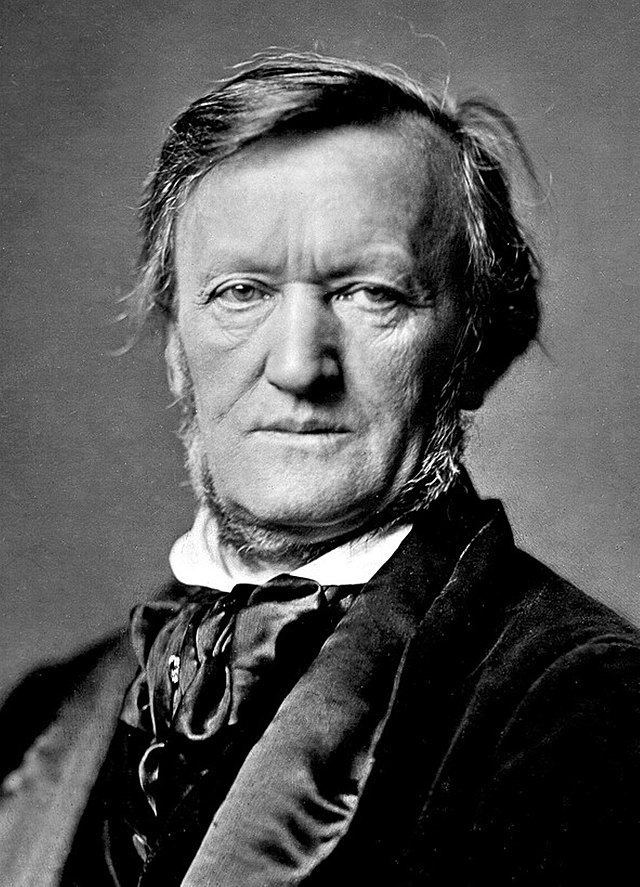
Richard Wagner
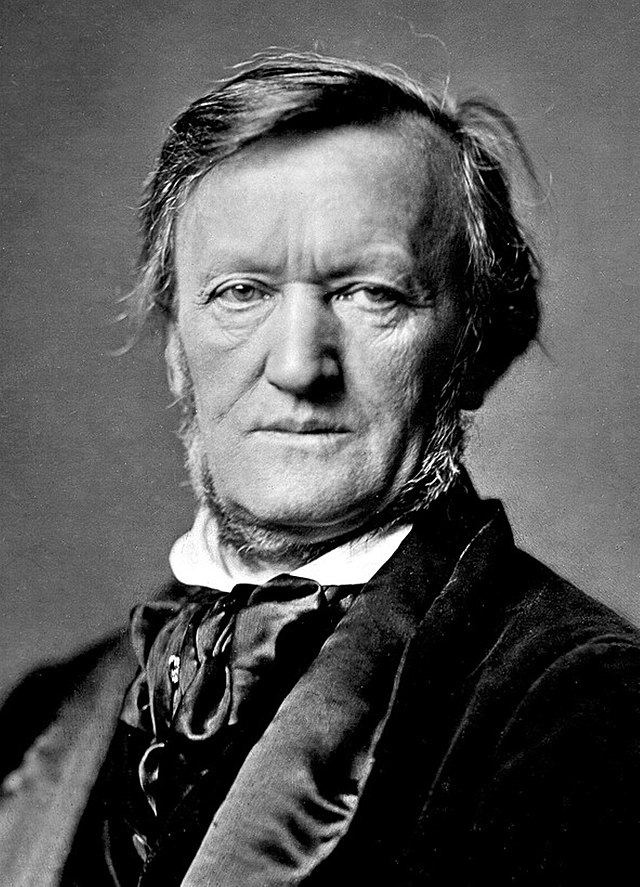
Richard Wagner (1813–1883) è un compositore german del periodo Romantic, con 18 opere e 8 arie archiviate nel database.
Ritratto tratto da Wikimedia Commons (pubblico dominio).
1813
1883
German
18
8
1832 – 1877
Leipzig
Venice
Wilhelm Richard Wagner was a German composer, theatre director, essayist, and conductor, best known for his operas, although his mature works are often referred to as music dramas. Unlike most composers, Wagner wrote both the libretti and the music for all of his stage works. He first achieved recognition with works in the Romantic tradition of Carl Maria von Weber and Giacomo Meyerbeer, but revolutionised the genre through his concept of the Gesamtkunstwerk, which sought to unite poetic, musical, visual, and dramatic elements. In this approach, the drama unfolds as a continuously sung narrative, with the music evolving organically from the text rather than alternating between arias and recitatives. Wagner outlined these ideas in a series of essays published between 1849 and 1852, most fully realising them in the first half of his four-opera cycle Der Ring des Nibelungen.
Vita di Richard Wagner
Nazionalità e periodo
Richard Wagner è un compositore German del periodo Romantic, vissuto dal 1813 al 1883, nato a Leipzig e morto a Venice.
Maestri e formazione
Richard Wagner studiò con Christian Theodor Weinlig — formazione che ne plasmò il linguaggio compositivo.
Allievi e discepoli
Tra gli allievi di Richard Wagner: Anton Seidl.
Vita e carriera
Richard Wagner was born on 22 May 1813 to an ethnic German family in Leipzig, then part of the Confederation of the Rhine. His family lived at No 3, the Brühl (The House of the Red and White Lions) in Leipzig's Jewish quarter. He was baptised at St. Thomas Church. He was the ninth, and youngest, child of Carl Friedrich Wagner, a clerk in the Leipzig police service, and his wife, Johanna Rosine Wagner, the daughter of a baker. Wagner's father Carl died of typhoid fever six months after Richard's birth. Afterwards, his mother Johanna lived with Carl's friend, the actor and playwright Ludwig Geyer. In August 1814 Johanna and Geyer probably married, although no documentation of this has been found in the Leipzig church registers. She and her family moved to Geyer's residence in Dresden. Until he was fourteen, Wagner was known as Wilhelm Richard Geyer. He almost certainly thought that Geyer was his biological father. Geyer's love of the theatre came to be shared by his stepson, and Wagner took part in his performances. In his autobiography Mein Leben Wagner recalled once playing the part of an angel. In late 1820, Wagner was enrolled at Pastor Wetzel's school at Possendorf, near Dresden, where he received some piano instruction from his Latin teacher. He struggled to play a proper scale at the keyboard and preferred playing theatre overtures by ear. Following Geyer's death in 1821, Richard was sent to the Kreuzschule, the boarding school of the Dresdner Kreuzchor, at the expense o…
Estratto dalla biografia Wikipedia di Richard Wagner — testo rilasciato con licenza CC BY-SA 4.0. Leggi la biografia completa →
Contributo all’opera
Richard Wagner ha lasciato 18 opere registrate in Wikidata, con 8 arie principali descritte in pagine dedicate.
Cronologia delle opere di Richard Wagner
10 opere rappresentate in 4 decenni di attività compositiva, raggruppate qui per decade di prima rappresentazione:
- 1832Die Hochzeit
- 1833Die Feen
- 1837Rienzi
- 1852Das Rheingold
- 1857Tristan und Isolde
- 1874Der Ring des Nibelungen
- 1874Götterdämmerung
- 1877Parsifal
Compositori contemporanei di Richard Wagner
Altri compositori del database nati nella stessa generazione di Richard Wagner (1813) — utile per collocare l’opera in un contesto generazionale:
- Giuseppe Verdi
1813–1901 · Italian · Romantic - Charles Gounod
1818–1893 · France · Romantic - Hector Berlioz
1803–1869 · France · Romantic - Bedřich Smetana
1824–1884 · Austria–Hungary · Romantic - Vincenzo Bellini
1801–1835 · Italian · Romantic
Elenco delle opere di Richard Wagner
in German · comic opera · libretto di Richard Wagner
in German
in German · opera, Musikdrama · libretto di Richard Wagner
in German
in German · opera, Musikdrama · libretto di Richard Wagner
in German · opera · libretto di Richard Wagner
in German · opera · libretto di Richard Wagner
Die Hochzeit
1832
in German · libretto di Richard Wagner
Die Feen
1833
in German · libretto di Richard Wagner
Rienzi
1837
in German · opera · libretto di Richard Wagner
in German · opera · libretto di Richard Wagner
Lohengrin
1848
in German · opera · libretto di Richard Wagner
Das Rheingold
1852
in German · opera · libretto di Richard Wagner
Tristan und Isolde
1857
in German · opera · libretto di Richard Wagner
in German · libretto di Richard Wagner
Götterdämmerung
1874
in German · opera, Musikdrama · libretto di Richard Wagner
Parsifal
1877
in German · opera · libretto di Richard Wagner
Arie principali di Richard Wagner
- Das Rheingold — Der Ring des Nibelungen (1848)
- Die Walküre — Der Ring des Nibelungen (1848)
- Götterdämmerung — Der Ring des Nibelungen (1848)
- Lohengrin – Act I — Lohengrin (1845)
- Lohengrin – Act II — Lohengrin (1845)
- Lohengrin – Act III — Lohengrin (1845)
- Lohengrin – Vorspiel — Lohengrin (1845)
- Siegfried — Der Ring des Nibelungen (1848)
Biografia ed elenco delle opere provenienti da Wikidata (CC0, pubblico dominio).